


This week:
Music Question: Bands You’d Least Expect to Use a Harmonica
Next: My weekly new music radio show. Week 1051.
Musical Thoughts. None this week.
When you think of the harmonica, your brain instantly maps out a very specific musical terrain. Right? The dusty folk-rock of Bob Dylan and Neil Young, or the gritty, smoke-filled clubs of Chicago blues legends like Little Walter. It’s an instrument built for roots, raw emotion, and front-porch simplicity.
But every now and then, a band rooted in heavy distortion, pristine pop architecture, or jagged alternative angst reaches into their gear bag and pulls out a mouth organ. When these artists subvert expectations - it becomes a secret weapon. Distorted through amplifiers, woven into wall-of-sound production, or used to inject a sudden burst of vulnerable, organic grit into an otherwise synthetic or heavy landscape.
Here is a look at the tracks where the harp makes an appearance in a musical world you’d least expect to find it.
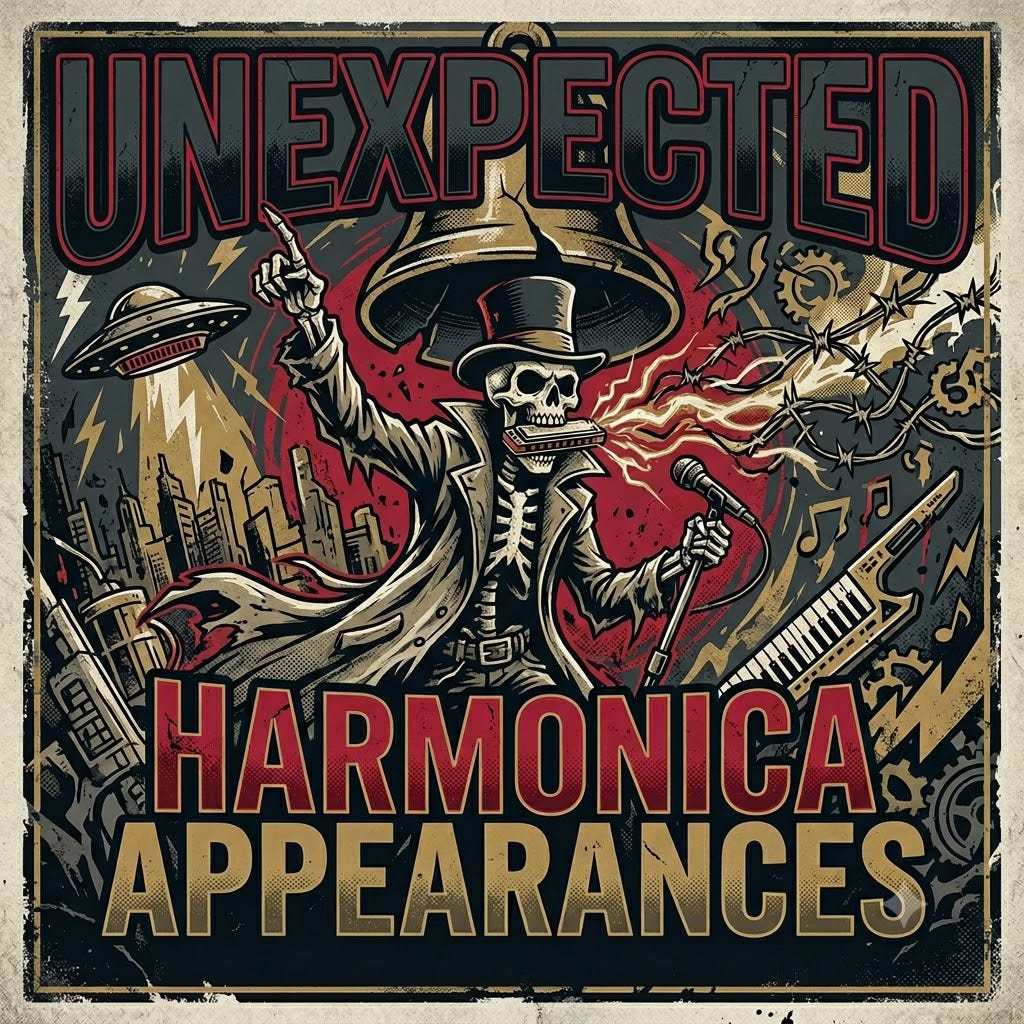
Alice in Chains — “Don’t Follow”
Coming from one of the sludgiest, darkest bands of the Seattle grunge era, this track from the Jar of Flies EP is a breathtaking curveball. It starts as a fragile, acoustic folk ballad sung by Jerry Cantrell. Right in the middle, a soulful, mournful harmonica solo glides in, bridging the gap before Layne Staley bursts in with his powerhouse, agonizing vocals. It adds a heartbreaking, campfire-isolated vibe you’d never expect from the masters of “Man in the Box.”
Supertramp — “Take the Long Way Home”
Supertramp is famous for pristine progressive pop, roaring saxophone solos, and the bright bark of the Wurlitzer electric piano. But “Take the Long Way Home” kicks off with a lonely, haunting, echoing harmonica melody played by Rick Davies. It sounds like someone whistling on a deserted street corner, perfectly setting up the song’s themes of isolation before the lush, upbeat piano groove takes over.
Black Sabbath — “The Wizard”
You don’t exactly expect the godfathers of heavy metal to kick off a track with a bouncy, folklore-sounding mouth organ. But before Tony Iommi’s massive, sludgy guitar riff drops in, Ozzy Osbourne himself blows a haunting, rhythmic harmonica intro. It gives the track an eerie, proto-metal-meets-delta-blues texture that they never really repeated.
Weezer — “My Name Is Jonas”
The opening track of Weezer’s Blue Album starts with a delicate, acoustic fingerpicking pattern that suddenly explodes into their signature wall of crunchy geek-rock power chords. Right at that transition, Rivers Cuomo bursts in with a bright, frantic harmonica blast that perfectly introduces the chaotic nostalgia of the album.
The Clash — “(White Man) In Hammersmith Palais”
The Clash were famous for smashing punk rock boundaries, but dropping a reggae-style harmonica line into an early punk single was an incredibly bold move. Mick Jones blows a soulful melody that weaves between Joe Strummer’s biting lyrics, grounding the song beautifully in its roots-reggae influences.
INXS — “Suicide Blonde”
INXS was the epitome of sleek, danceable Australian new wave and alternative rock. So when they needed a gritty, screeching hook for “Suicide Blonde,” they didn’t use a synth—they hired blues legend Charlie Musselwhite. Turned up high in the mix and heavily processed, the harmonica mimics a frantic horn section, fitting perfectly into their late-’80s club rock vibe.
Pearl Jam — “Smile”
Another brilliant moment where the Seattle scene embraced the harp. On No Code, Eddie Vedder dons a harmonica holder (a direct nod to his love for Neil Young) to anchor “Smile.” Played over Stone Gossard’s droning, distorted guitar chord progression, the raw, unpolished wail of the harmonica adds an incredibly vulnerable, rustic layer to the track.
XTC — “The Ballad of Peter Pumpkinhead” & “In Another Life”
As architects of brilliant, complex indie-pop, XTC isn’t a band you associate with the blues harp. Yet on “The Ballad of Peter Pumpkinhead” (Nonsuch, 1992), Andy Partridge uses a blaring, driving harmonica to push the track’s propulsive folk-rock energy. To avoid a pristine pop sound, Partridge notably plugged the harmonica (and his vocals) directly into a small, overdriven amplifier to achieve a dirty, aggressive, and distorted blues tone. They leaned into the instrument again on “In Another Life” (Wasp Star, 2000), this time featuring bassist Colin Moulding on harmonica for a jaunty, down-to-earth track that was specifically inspired by the band’s deep jug band and early rock and roll roots.
Ministry — “Filth Pig”
If Black Sabbath using a harmonica is surprising, industrial metal pioneers Ministry using one is downright shocking. On the title track of Filth Pig, Al Jourgensen takes an instrument typically known for warmth and bends it into a screeching, metallic nightmare. It is layered deep within a wall of agonizing guitar noise, sounding more like a factory siren than a blues harp.
U2 — “Trip Through Your Wires” & “Desire”
During The Joshua Tree and Rattle and Hum eras, U2 deeply immersed themselves in American blues, gospel, and rock traditions. On “Trip Through Your Wires,” Bono steps up on the mouth harp to drive a loose, whiskey-soaked blues groove that feels miles away from their polished post-punk roots. They doubled down on this raw energy with “Desire,”where the entire driving, Bo Diddley-inspired rhythm is propelled by a famous, wailing harmonica part that gives the track its gritty, hyper-charged engine.
The “Cheat” Sheet: Tom Petty’s Harmonica Staples
You can never have too much Tom Petty. Everyone needs a little more TP in their life. There is something magical about the way he and the Heartbreakers could take a dead-simple harmonica part and turn it into the emotional anchor of an entire track.
While Tom Petty fits much closer to the classic rock/folk-rock lineage where you might expect a harmonica, people often overlook just how central the instrument is to the DNA of some of his finest, most atmospheric tracks.
“You Don’t Know How It Feels” — The ultimate laid-back, late-night groove. The entire track is anchored by a heavy, looping drumbeat and a prominent, instantly recognizable main E harmonica riff that acts as the song’s secondary vocal. Just when you think the groove has settled completely, Petty caps it all off with a brilliant, airy A harmonica solo that feels like rolling the windows down on an empty highway.
“Mary Jane’s Last Dance” — Frequently cited for its iconic A-minor harp breaks that give the track its haunting, mysterious, road-weary edge. The harmonica sounds lonely, cinematic, and slightly dangerous. Live - it instantly electrifies the room and pulls everyone right into that dark, swampy Indiana groove. (And I love that Kate’s band covers this song with Kate playing the harmonica too)
“Wildflowers” — The title track from his 1994 masterpiece is an exercise in beautiful restraint. Instead of driving the rhythm, Petty uses subtle, sweet harmonica layers to color the margins of a gorgeous, acoustic goodbye letter. The harp lines drift in and out like a gentle breeze, perfectly matching the song’s themes of freedom, peace, and letting go of someone you love.
“Fault Lines” — A brilliant deeper cut from 2014’s Hypnotic Eye that showcases his incredible later-career groove. On this track, the harmonica abandons the sunny folk-rock warmth of his ‘90s work and gets down in the dirt. Petty uses the harp to accent a tense, trembling, and anxious blues-rock rhythm, proving that even four decades into his career, he could still make the instrument sound sharp, gritty, and vital.
What makes these tracks work so beautifully is the element of friction. By dropping a centuries-old folk instrument into the middle of alternative rock anthems, progressive pop suites, or industrial metal noise walls, these artists managed to disrupt their own sonic formulas.
The harmonica isn’t just a relic of traditional blues or campfire singalongs. No. It’s for everyone! It’s an incredibly versatile, deeply expressive tool capable of cutting through any genre when a song calls for an extra dose of raw human energy. A reminder that in music - the best moments usually happen when you throw out the rulebook, pivot away from the expected, and just turn it up.
Swim Deep – “You, Me, And Mary”
This track delivers a beautiful, sun-drenched swirl of indie-pop that feels like catching a second wind on a warm afternoon. It’s got a hazy, rolling rhythm and a massive melodic hook that completely wraps around you. Sounds like:The Stone Roses and Jagwar Ma.
Johnny Marr – “Spin”
One of the most iconic guitar architects in rock history returns with a track that hits the ground running. It’s packed with his signature fluid, shimmering fretwork and a relentless driving energy that commands your full attention. Sounds like:The Smiths and Electronic.
The Legal Matters – “It Doesn’t Matter”
If you are a sucker for gorgeous, crystal-clear vocal harmonies and timeless power-pop songwriting, this is your sweet spot today. It’s a crisp, beautifully crafted tune that gives your ears an instant reason to smile. Sounds like: Teenage Fanclub and The Posies.
Cola – “Hedgesetting”
This is a sharp, fiercely intelligent piece of angular post-punk that relies on a tight, minimalist groove. It builds a fascinating, nervous tension with its rhythmic guitar work and clever, spoken-style delivery. Sounds like: Parquet Courts and Television.
The Dahlmanns – “What’s Inside A Mind”
Get ready for a blast of pure, high-octane garage-pop adrenaline coming straight out of Norway. It’s fast, it’s incredibly catchy, and it carries a brilliant, vintage fuzz-rock energy that will have you tapping the wheel immediately. Sounds like:The Ramones and The Primitives.
Weird Nightmare – “Where I Belong”
This project brings a fantastic mix of raw, distorted noise and undeniable pop hooks. It’s fuzzy, slightly chaotic, and carries a beautifully melodic core that proves you can mix grit with an absolute earworm of a chorus. Sounds like: Matthew Sweet and Guided By Voices.
Ultra Lights – “Good Enough”
This track glides out of the speakers with a smooth, atmospheric indie-rock confidence. It layers lush, shimmering guitars over a steady, confident beat, making it the perfect soundtrack for a long, open highway drive. Sounds like: The Strokes and DIIV.
Case/Lang/Veirs – “Accidental Tattoo”
We are celebrating a decade of musical brilliance with this anniversary spin from a legendary indie-folk supergroup. The vocal blend between these three distinct powerhouses is absolutely breathtaking and deeply moving. Sounds like: Neko Case and boygenius.
Midred – “Fenceline”
This is a gorgeous, slow-burning piece of alternative indie that feels incredibly intimate. It slowly unfolds with a raw, acoustic foundation before building into a rich, emotional landscape that stays with you long after the song ends. Sounds like: Phoebe Bridgers and Big Thief.
SOAK – “Death Valley Fridge Magnet”
An absolutely stunning return that balances intricate, poetic storytelling with a lush, expanding indie-pop production. It captures a beautiful, vulnerable melancholy that pulls you right into its unique sonic world. Sounds like: Julien Baker and Holly Humberstone.
Eels – “Cap In Hand”
Mark Oliver Everett is back with his signature blend of quirky instrumentation, bittersweet grit, and brilliant songwriting. It’s a beautifully understated, soulful track that reminds you why his catalog is so deeply cherished. Sounds like: Beck and Tom Waits.
Elizabeth Moen – “Renaissance Man”
Prepare to be completely stopped in your tracks by an absolute powerhouse of a vocal performance. This track drips with soulful, bluesy alternative grit and a fierce lyrical honesty that demands you crank the volume right up. Spencer Tweedy drums and produces. Sounds like: Brittany Howard and Sharon Van Etten.
Olivia Rodrigo – “Purple”
Stepping away from the stadium-sized pop anthems, this track highlights a beautifully raw, stripped-back alternative vulnerability. It relies on a haunting melody and a deeply personal lyric that completely fills the room. Sounds like: Lorde and Fiona Apple.
The Snuts – “Summer Rain”
This Scottish outfit delivers an absolute firecracker of an indie-rock anthem. It’s packed with infectious, bouncing rhythms, a massive sing-along chorus, and a high-energy swagger that is completely contagious. Sounds like: Arctic Monkeys and Kasabian.
Hard-Fi – “Always and Forever (Remastered)”
We are closing out this week’s set of discoveries with a beautifully polished, high-energy blast of 2000s indie-dance history. The remaster makes those sharp guitars, pulsing basslines, and soul-stomp choruses sound bigger and bolder than ever. Sounds like: The Clash and Franz Ferdinand.
and remember if you love someone hug them right now!
Start Today-Gorilla Biscuits.
Not a band (girl group!), but probably the most unlikely song in modern music to feature a harmonica solo:
https://youtu.be/9ro0FW9Qt-4?is=yOh4QLT0g_Tgunya